Jeyuk-bokkeum
Thin slices of pork tossed in a sweet, spicy gochujang sauce, then stir-fried over high heat with onion and scallions until the edges start to char. It's an everyday favorite at Korean home tables and set-meal restaurants, and it's made to be eaten with a bowl of rice. About 40 minutes for three, including a 20-minute marinade.
- Time
- 40 min
- Level
- Easy
- Spice
- Serves
- 3
What is Jeyuk-bokkeum?
WHAT IT IS
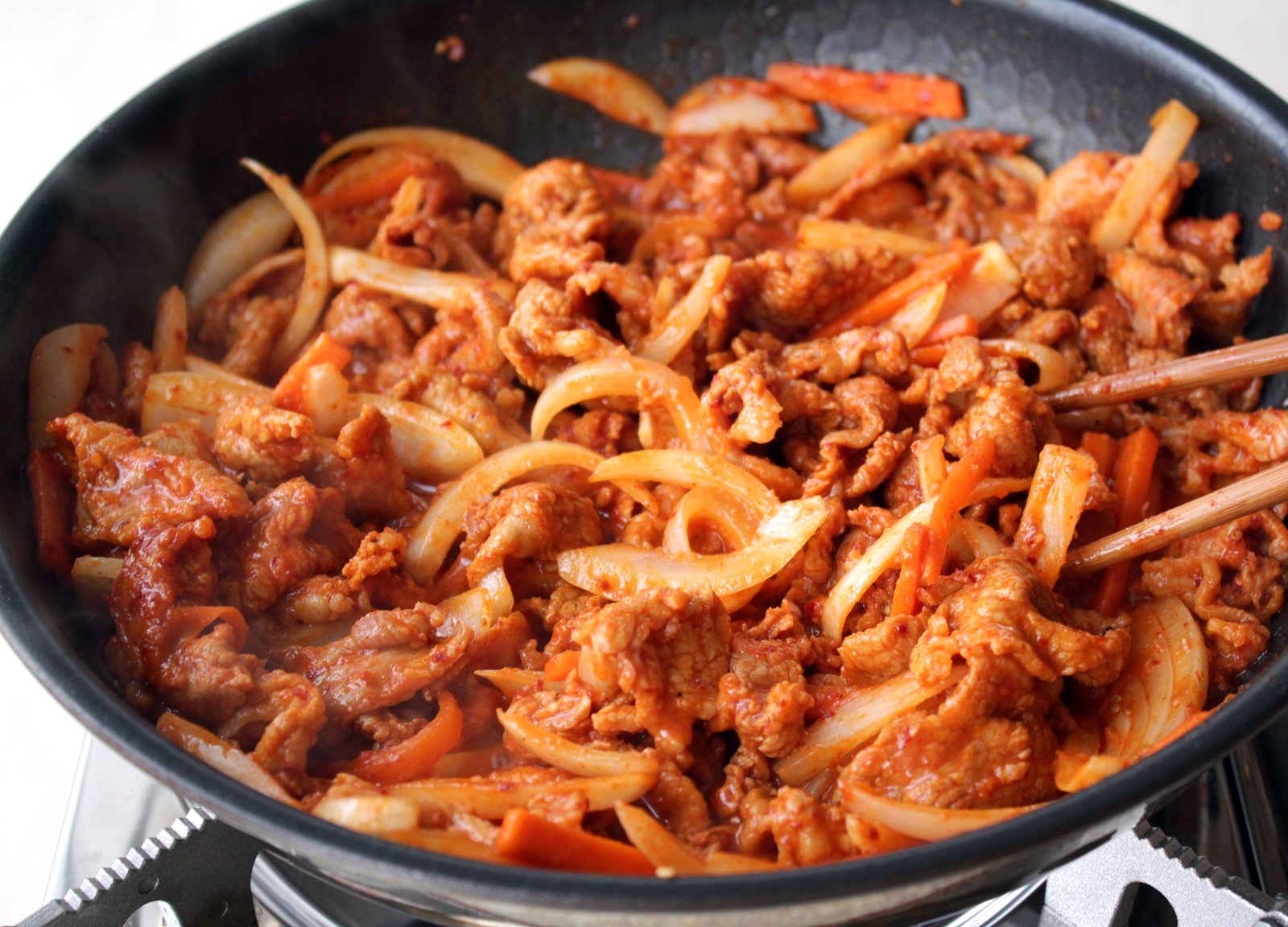
Jeyuk-bokkeum is pork, usually thinly sliced shoulder or belly, stir-fried in a sauce of gochujang, gochugaru, soy sauce, garlic and a little sugar. It's sweet, spicy and slightly charred at the edges, and it's almost always eaten with rice, often wrapped in a lettuce leaf. In Korea it's a staple of home cooking and of the inexpensive set-meal restaurants where people grab lunch.
WHERE IT COMES FROM
Jeyuk is an everyday Korean word for pork: the Standard Korean Language Dictionary defines it as pig meat eaten as food, and it is generally explained as a softened form of jeoyuk (猪肉, "pig meat"). So the name simply means "stir-fried pork." The Encyclopedia of Korean Culture lists jeyuk-bokkeum among Korea's moist-heat stir-fries, alongside dishes such as stir-fried octopus (nakji-bokkeum). No single inventor or date is recorded.
Sources:Encyclopedia of Korean Culture (볶음)Standard Korean Language Dictionary (제육)National Institute of Korean Language (한식명 로마자 표기 및 표준 번역, 2014)
Ingredients
재료Each Korean item has a substitute, in case you can’t get to a store.
Paid links · The store links in this list are affiliate links: K for All earns a commission when you buy through them. Sales, shipping and refunds are handled by each store.
- 1⅓ lb (600 g)Pork shoulder (butt) or belly, thinly sliced 돼지고기
Substitute: Shoulder is leaner and belly is richer; many cooks mix the two. Korean grocers sell pork pre-sliced for stir-frying, about ⅛ inch (3 mm) thick. To slice your own, freeze the meat for 1–2 hours first so it cuts cleanly.
Any grocer - 1 mediumOnion, sliced about ¼ inch (5 mm) thick 양파Any grocer
- 2Scallions, cut into 2-inch (5 cm) pieces 대파Any grocer
- ½ small (optional)Carrot, cut into thin strips 당근Any grocer
- 3 tbspGochujang 고추장
CJ Haechandle Gochujang (Hot Pepper Paste) · 500 g
Check price on Amazon Amazon US - 1½ tbspGochugaru (Korean red pepper flakes) 고춧가루
Taekyung Red Pepper Powder · 1 lb
Substitute: It gives the sauce its red color and a clean heat. Use 1 tsp for a milder plate, or add a sliced fresh chili for more.
Check price on Amazon Amazon US - 2 tbspSoy sauce 간장
Sempio Korean Soy Sauce, Rich and Delicate · 860 ml
Check price on Amazon Amazon US - 1 tbspSugar 설탕In your pantry
- 1 tbspCorn syrup (mulyeot) or honey 물엿
Chung Jung One O’Food Corn Syrup · 1.2 kg
Substitute: It adds gloss and helps the sauce cling to the pork. Honey or rice syrup works too, or use 2 tsp more sugar.
Check price on Amazon Amazon US - 1 tbspRice wine or mirin 맛술
Kikkoman Manjo Aji-Mirin · 10 fl oz × 4
Substitute: Korean mirim, Japanese mirin or a dry rice wine all work; it takes the edge off any porky smell.
Check price on Amazon Amazon US - 3 cloves (1 tbsp)Garlic, minced 다진 마늘Any grocer
- 1 tbspToasted sesame oil 참기름
Otoki Premium Roasted Sesame Oil · 10.82 fl oz
Check price on Amazon Amazon US - 1 tsp grated ginger, ¼ tsp black pepper, 1 tbsp cooking oil, and toasted sesame seeds to finishIn your pantry
-
- To serve (optional)Lettuce or perilla leaves, for wrapping 상추
Substitute: Wrap a piece or two of pork in a leaf with a little rice. A dab of ssamjang is good in the wrap too.
Any grocer


Method
만드는 법Sources we compared:Korean Bapsang10000recipe
- 1
Prep the pork and vegetables
Lay the pork slices on paper towels and press lightly to soak up any blood. Cut long slices into bite-size pieces, about 2 inches (5 cm). Slice the onion, cut the scallions into 2-inch pieces, and cut the carrot into thin strips if you're using it.
- 2
Mix the sauce
In a large bowl, stir together 3 tbsp gochujang, 1½ tbsp gochugaru, 2 tbsp soy sauce, 1 tbsp sugar, 1 tbsp corn syrup, 1 tbsp rice wine, the garlic, the ginger and the black pepper until smooth.
For a rounder, fruitier sauce, swap some of the sugar for 2–3 tbsp grated apple or Asian pear, or 1–2 tbsp Korean plum syrup (maesil-cheong).
- 3
Marinate the pork
Add the pork to the bowl and massage the sauce in with your hands (food-safe gloves help) until every piece is coated. Drizzle in the sesame oil and toss again. Cover and leave it for 20 minutes at room temperature, or up to a day in the refrigerator.
In a hurry? Skip the marinade. Cooks at Korean drivers' diners (gisa sikdang) often sear the plain pork first with a splash of soy sauce, then add the vegetables and the sauce to the hot pan.
- 4
Stir-fry over high heat
Heat the oil in a wok or large skillet over high heat. Spread the pork in the pan and let it sear for a minute before stirring, then stir-fry for 4–5 minutes, until no pink remains. Add the onion and carrot and keep stirring for 2–3 minutes, until the onion turns translucent and the sauce darkens and clings to the meat. Turn the heat down to medium if the sauce starts to scorch. Add the scallions for the last 30 seconds.
If your pan is smaller than 12 inches, cook in two batches. A crowded pan steams the pork instead of searing it, and the sauce turns watery.
- 5
Serve with rice
Sprinkle with sesame seeds and serve hot with steamed rice, kimchi and a few lettuce leaves. For a wrap (ssam), put a piece of pork and a little rice on a leaf, fold it up and eat it in one bite.
Leftovers make jeyuk-deopbap: spoon the reheated pork over a bowl of rice, with a fried egg on top if you like.
Say it in Korean
한국어로 말해 보세요For a Korean set-meal restaurant (baekban-jip) or a drivers' diner (gisa sikdang).

Cookware you’ll need
조리 도구Any wide, heavy pan works. For high-heat stir-frying, this is the wok we link to.