Kimchi jjigae
Sour, well-fermented kimchi simmered with pork belly and tofu: Korea's everyday stew. In episode 1 of We Are All Trying Here, one order of it starts a petty war between two old rivals at a kimchi-jjigae restaurant opening. About 35 minutes for two.
- Time
- 35 min
- Level
- Easy
- Spice
- Serves
- 2
What is Kimchi jjigae?
WHAT IT IS
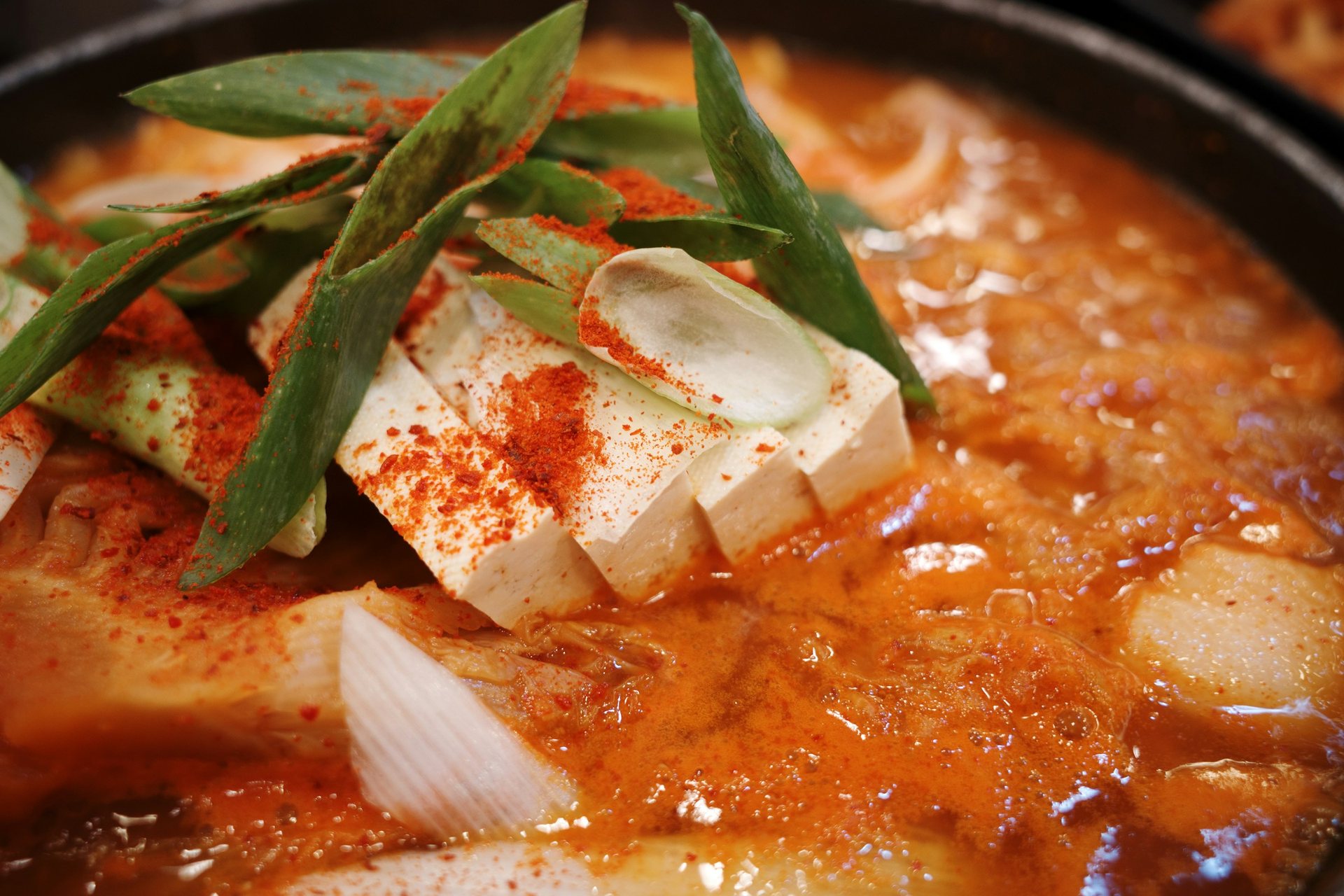
Kimchi jjigae is well-fermented, sour kimchi simmered with pork and tofu, Korea's most everyday stew after doenjang jjigae. It is the classic way to use up kimchi that has grown too sour to eat as it is.
WHERE IT COMES FROM
Red, chili-seasoned kimchi only took shape after chili peppers reached Korea in the mid-Joseon period, so kimchi stew is thought to have come after that. Jjigae first appears as a dish of its own in the late-19th-century cookbook Siuijeonseo under the name jochi, and the royal court called this one kimchi jochi, made with beef and steamed in a pot. Today's version, with sour kimchi and pork stir-fried in the pot before the water goes in, appears in a 1977 kimchi guide from the magazine Yeoseong Donga.
Sources:Encyclopedia of Korean CultureEncyclopedia of Korean Folk Culture
Ingredients
재료Each Korean item has a substitute, in case you can’t get to a store.
Paid links · The store links in this list are affiliate links: K for All earns a commission when you buy through them. Sales, shipping and refunds are handled by each store.
- 1½ cups packed (about 10 oz / 300 g), plus ¼ cup of its juiceWell-fermented (sour) napa cabbage kimchi 신김치
Substitute: The older and sourer the kimchi, the deeper the broth. If you have no kimchi juice, add a little more broth and season with salt at the end.
Search on Amazon Amazon US - 5 oz (150 g)Pork belly or shoulder, thinly sliced 돼지고기 삼겹살
Substitute: Pork neck (moksal) is a favorite in Korea too. A cut with some fat makes the broth rich.
Any grocer - ½ block (about 7 oz / 200 g)Firm or medium tofu 두부Any grocer
- 2Scallions, sliced on the diagonal 대파Any grocer
- ½ smallOnion, sliced 양파Any grocer
- 2 tspGochugaru (Korean red pepper flakes) 고춧가루
Taekyung Red Pepper Powder · 1 lb
Substitute: Cut it back or skip it for a gentler pot.
Check price on Amazon Amazon US - 2 tspGochujang 고추장
CJ Haechandle Gochujang (Hot Pepper Paste) · 500 g
Substitute: It thickens the broth slightly and softens the sourness. Leave it out for a cleaner, sharper kimchi taste.
Check price on Amazon Amazon US - 2 cloves (2 tsp)Garlic, minced 다진 마늘Any grocer
- 2 cups (500 ml)Water or anchovy broth 물 또는 멸치 육수
Substitute: Plain water is fine. For a deeper broth, dissolve an anchovy broth tablet in the water, following the pack.
Search on Amazon Amazon US - 2 tspCooking oil or toasted sesame oil 식용유In your pantry
- A pinch of sugar if the kimchi is very sour; salt or soup soy sauce and black pepper, to tasteIn your pantry
-


Method
만드는 법Sources we compared:MaangchiMy Korean Kitchen10000recipe
- 1
Prep the kimchi, pork and tofu
Squeeze the kimchi lightly over a bowl to catch its juice, then cut it into bite-size pieces. Slice the pork thinly into bite-size pieces and season it with a pinch of black pepper. Cut the tofu into slabs about ½ inch thick, slice the onion and slice the scallions on the diagonal.
Young, crunchy kimchi makes a flat-tasting stew. If yours is fresh, leave the jar at room temperature for a day or two to sour before you cook.
- 2
Fry the pork, then the kimchi
Heat the oil in a medium pot over medium-high heat. Add the pork and stir until it loses its pink color and starts to release its fat, about 2 minutes. Add the kimchi, garlic and gochugaru and keep stirring for 4–5 minutes, until the kimchi turns soft and glossy and smells toasty.
To make it mild, the way Kyung-se orders it for Dong-man, leave out the gochugaru and the gochujang.
- 3
Add the liquid and simmer
Stir in the kimchi juice and gochujang, then pour in the 2 cups of water or broth and add the onion. When it comes to a boil, cover, turn the heat down to medium and simmer for 12–15 minutes, until the kimchi is very tender and the broth has turned deep red. Top up with a splash of water if it cooks down too far.
- 4
Add the tofu and season
Lay the tofu on top and spoon some broth over it. Taste: if the stew is very sour, add a pinch of sugar; if it needs salt, add a little salt or soup soy sauce. Simmer uncovered for 5 minutes, add the scallions and a little black pepper, and turn off the heat.
- 5
Serve it bubbling
Bring the pot straight to the table and serve with bowls of rice and a few side dishes; a rolled omelet is a classic partner.
No pork? Canned tuna is a popular swap in Korea, where the stew is then called chamchi kimchi jjigae.


Say it in Korean
한국어로 말해 보세요For a kimchi-jjigae restaurant (gimchi-jjigae jip).

Cookware you’ll need
조리 도구Any small to medium pot works for cooking. To bring a portion to the table still bubbling, restaurant style, here is the 44 fl oz stone pot we link to.