Galbitang
Beef short ribs simmered with Korean radish, garlic and ginger into a clear, deeply beefy broth, finished with glass noodles and chopped scallions. Most of the time is hands-off simmering. About 150 minutes for four, including soaking the ribs.
- Time
- 150 min
- Level
- Easy
- Spice
- Serves
- 4 servings
What is Galbitang?
WHAT IT IS
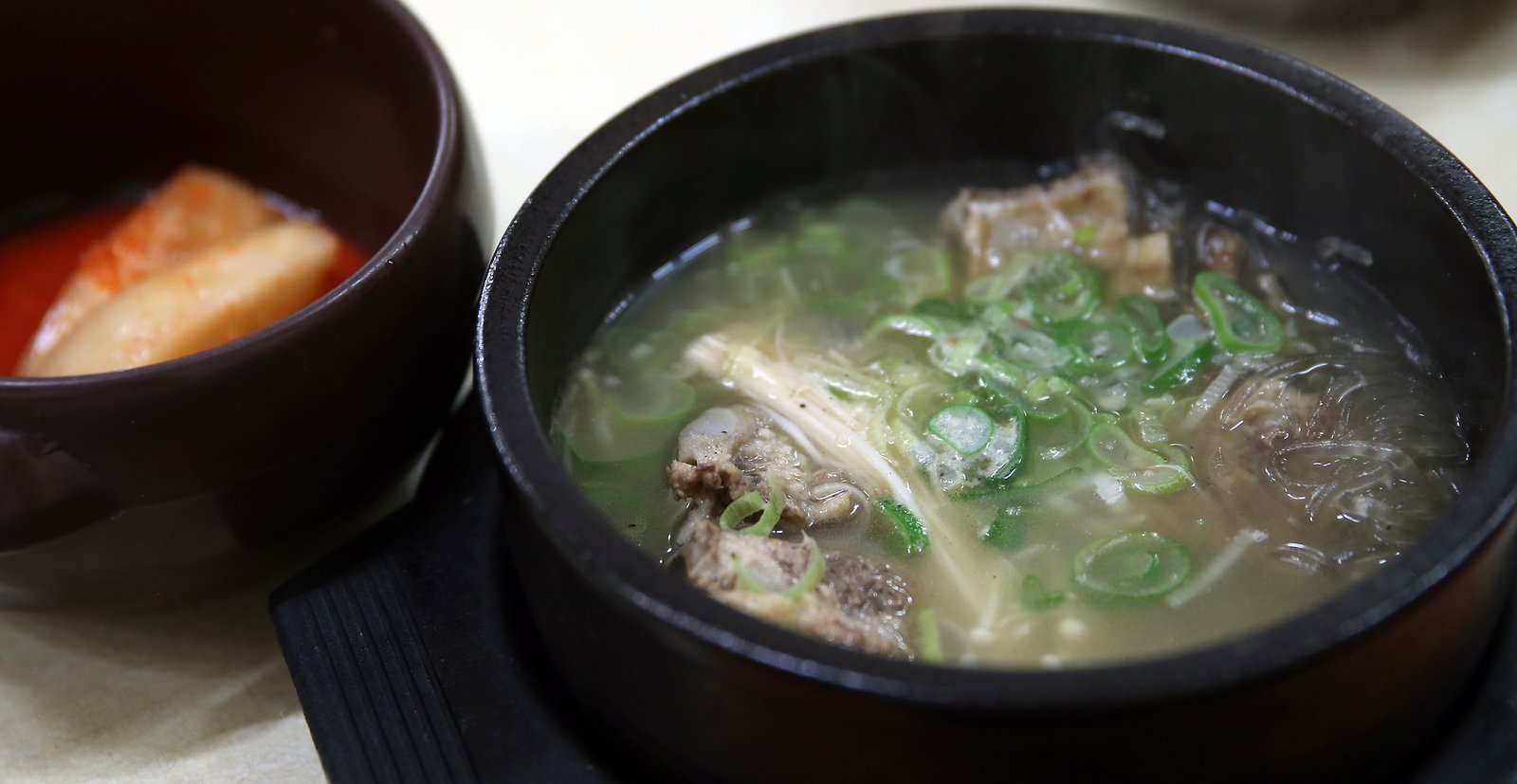
Galbitang is a clear soup of beef short ribs simmered until the meat nearly falls off the bone, usually with Korean radish and a few glass noodles. It's seasoned lightly with soup soy sauce and salt and served with rice and kimchi, often in a heavy earthenware bowl.
WHERE IT COMES FROM
Galbitang, also called garitang, first appears in writing on the menus of royal court banquets in the 1890s. Koreans are thought to have eaten beef ribs much earlier, perhaps since the late Goryeo period, but that is an educated guess rather than a record. Because the ribs simmer bone and all, the bones flavor the broth too, which is why it tastes richer than other clear soups while staying clear.
Ingredients
재료Each Korean item has a substitute, in case you can’t get to a store.
Paid links · The store links in this list are affiliate links: K for All earns a commission when you buy through them. Sales, shipping and refunds are handled by each store.
- 3 lb (1.4 kg)Bone-in beef short ribs, cut into 2–3-inch (5–7 cm) pieces 소갈비
Substitute: Ask for English-cut short ribs, not thin flanken (LA galbi) strips. Korean grocers sell them already cut for galbitang.
Any grocer - 1 lb (450 g)Korean radish (mu), cut into 2 or 3 large chunks 무
Substitute: Daikon works too; it's a little milder and softens faster.
Any grocer - 1 mediumOnion, halved 양파Any grocer
- 1 Korean daepa or 4 scallionsKorean scallion (daepa) or scallions: the white parts for the broth, the greens finely chopped to serve 대파Any grocer
- 8 cloves, plus 1 tsp mincedGarlic: whole peeled cloves for the broth, minced to finish 통마늘Any grocer
- 1-inch (2–3 cm) pieceFresh ginger, thinly sliced 생강Any grocer
- 2 tbspKorean soup soy sauce (guk-ganjang) 국간장
Sempio Soy Sauce for Soup (guk-ganjang) · 860 ml
Substitute: It's lighter in color and saltier than regular soy sauce, so the broth stays clear. With regular soy sauce, use just 1 tbsp and finish with salt.
Check price on Amazon Amazon US - 2 oz (60 g), optionalSweet potato glass noodles (dangmyeon) 당면
Ottogi Korean Vermicelli Premium Glass Noodles (Dangmyeon) · 500 g
Substitute: Soak them in warm water for 30 minutes before step 4.
Check price on Amazon Amazon US - 12 cups (3 L), plus more for soaking and parboilingWater 물In your pantry
- Salt and black pepper, to tasteIn your pantry
- To serveSteamed rice, with kimchi or kkakdugi (radish kimchi) 밥
Nishiki Premium Medium Grain Rice · 5 lb
Check price on Amazon Amazon US


Method
만드는 법Sources we compared:Korean Bapsang10000recipe
- 1
Soak the ribs
Cover the ribs with cold water and soak for 30 minutes to 1 hour, changing the water once, to draw out the blood. While you wait, trim off any thick pieces of hard white fat.
Soaking, plus the quick boil in step 2, is what keeps the broth clear instead of cloudy and gray.
- 2
Parboil and rinse
Bring a large pot of water to a boil, add the drained ribs and boil hard for 5 minutes, until gray scum rises. Drain, rinse each rib under running water and wash out the pot.
- 3
Simmer the broth
Return the ribs to the clean pot with 12 cups (3 L) water, the radish, onion, scallion whites, whole garlic and ginger. Bring to a boil and cook uncovered over medium-high heat for 30 minutes, skimming off any foam. When a chopstick slides easily into the radish, lift it out and set it aside. Turn the heat to medium-low, cover and simmer for about 1 hour more, until the meat is tender and starts to pull away from the bone.
If the liquid drops below the ribs, add a little water. You want about 8 cups (2 L) of broth at the end.
- 4
Skim and season
Fish out and discard the onion, scallion, garlic and ginger, and skim as much fat from the surface as you can with a ladle. Cut the radish into bite-size slices and return it to the pot, stir in 2 tbsp soup soy sauce and 1 tsp minced garlic, and season with salt and pepper. Add the drained noodles and boil for 3–4 minutes, until soft.
Making it ahead? Chill the whole pot overnight: the fat sets on top in a layer you can lift off, and the broth comes out cleaner.
- 5
Serve with rice and kimchi
Ladle 2 or 3 ribs into each bowl with radish, noodles and plenty of broth, and scatter the chopped scallion greens on top. Serve with rice and kimchi or kkakdugi, and pull the meat off the bones with chopsticks as you eat.
For dipping the meat, mix 1 tbsp soy sauce, ½ tbsp vinegar, 1 tsp sugar and ½ tsp mustard.
Say it in Korean
한국어로 말해 보세요For a galbitang restaurant.
Cookware you’ll need
조리 도구Cook it in a large stockpot (at least 6 quarts / 6 L). To serve it bubbling, restaurant style, here's the 44 fl oz stone pot we link to.