Bossam
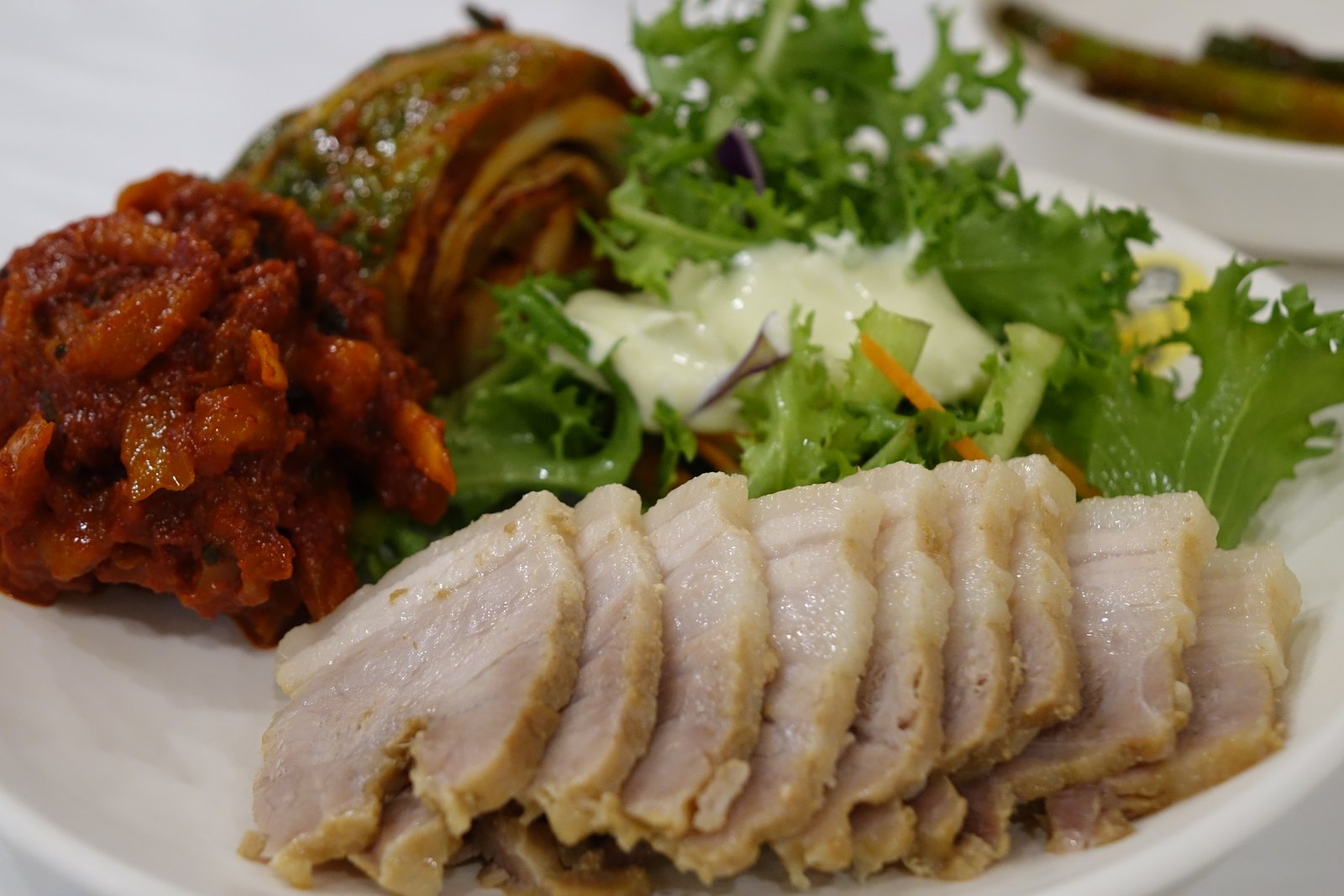
Pork belly simmered with doenjang, garlic and ginger until tender, then sliced and wrapped in salted napa cabbage with spicy radish salad and a little salted shrimp. It's a classic on kimchi-making day. About 90 minutes for four.
- Time
- 90 min
- Level
- Easy
- Spice
- Serves
- 4
What is Bossam?
WHAT IT IS
Bossam is pork belly or shoulder simmered in a seasoned broth until tender, then thinly sliced and eaten as a wrap (ssam). Each bite is a slice of pork tucked into a salted napa-cabbage or lettuce leaf with spicy radish salad, kimchi and a dab of salted shrimp. It's a sharing platter, ordered for the table at bossam restaurants and often for delivery.
WHERE IT COMES FROM
Boiled, pressed and sliced pork (pyeonyuk) is an old dish, eaten with salted-shrimp sauce, and Korea's encyclopedias note it was also wrapped in cabbage kimchi, much as bossam is today. According to the Encyclopedia of Korean Folk Culture, pork bossam as we know it was presented at a 1986 cooking contest, and bossam restaurants caught on around the same time. It also belongs to gimjang, the autumn kimchi-making: a National Folk Museum of Korea curator recalls the host boiling pork into jeyuk-pyeonyuk for the neighbors who came to help.
Sources:Encyclopedia of Korean CultureEncyclopedia of Korean Folk CultureNational Folk Museum of KoreaKorea Tourism Organization
Ingredients
재료Each Korean item has a substitute, in case you can’t get to a store.
Paid links · The store links in this list are affiliate links: K for All earns a commission when you buy through them. Sales, shipping and refunds are handled by each store.
- 2¼ lb (1 kg)Skinless pork belly in 2 or 3 thick pieces (or boneless pork shoulder) 돼지고기 삼겹살
Substitute: Belly is the juiciest; shoulder (pork butt) is leaner but still tender. Pieces about 3 inches (7–8 cm) wide cook through evenly.
Any grocer - 2 tbspDoenjang (Korean fermented soybean paste) 된장
CJ Haechandle Doenjang (Korean Soybean Paste) · 500 g
Substitute: It seasons the pork lightly and takes away any porky smell. Japanese miso works in a pinch.
Check price on Amazon Amazon US - 1 mediumOnion, halved 양파Any grocer
- 2Large scallions, white parts (or 1 small leek) 대파Any grocer
- 8 clovesGarlic, whole 통마늘Any grocer
- 1-inch piece (about 15 g)Ginger, sliced 생강Any grocer
- 8 cups (2 L)Water, enough to cover the pork 물In your pantry
- 1 lb (450 g)Korean radish (mu) or daikon, for the radish salad 무Any grocer
- 2 tbspGochugaru (Korean red pepper flakes), for the radish salad 고춧가루
Taekyung Red Pepper Powder · 1 lb
Substitute: Use 1 tbsp for a milder salad.
Check price on Amazon Amazon US - For the pot: 1 tsp whole black peppercorns, 1 tsp salt, and 1 tsp instant coffee and 2 bay leaves (both optional). For the salad: 1 tsp salt, 1 tbsp each sugar, rice vinegar and fish sauce, 1 tsp minced garlic, 1 chopped scallion and 1 tsp sesame seedsIn your pantry
- 1 small headNapa cabbage, inner leaves (or lettuce) 알배추
Substitute: To salt the leaves you'll also need ¼ cup coarse salt. No time? Serve crisp lettuce and perilla leaves instead; they need no prep.
Any grocer - 2 tbspSaeujeot (salted fermented shrimp), for dipping 새우젓
Substitute: Sold in jars in the refrigerated section of Korean grocers. Without it, a little ssamjang, or salt with a drop of sesame oil, works.
Any grocer -
- To serve (optional)Ssamjang (seasoned soybean dipping paste) 쌈장
Chung Jung One O’Food Ssamjang (Seasoned Soybean Paste), Mild · 500 g
Substitute: Many people like it in the wrap instead of, or as well as, the salted shrimp.
Check price on Amazon Amazon US


Method
만드는 법Sources we compared:MaangchiKorean BapsangMy Korean Kitchen
- 1
Make the cooking liquid
Put the 8 cups (2 L) of water in a large pot with the doenjang, onion, scallions, garlic, ginger, peppercorns and salt, plus the coffee and bay leaves if using. Stir to dissolve the doenjang and bring to a boil over medium-high heat. Let it boil for 5 minutes so the aromatics flavor the water.
- 2
Simmer the pork until tender
Add the pork; it should be just covered (top up with water if not). Bring back to a boil and boil uncovered for 5 minutes, then cover, turn the heat to medium-low and simmer for 45–60 minutes, turning the pieces once. It's done when a chopstick slides into the thickest part with no resistance and the juices run clear; by then a thermometer reads far above 145°F (63°C), the safe minimum for pork. Turn off the heat and leave the pork in the liquid while you finish the sides.
Korean cooks often add instant coffee, beer or soju to the pot. It masks any porky smell and tints the meat light brown; you won't taste coffee.
- 3
Salt the cabbage while the pork cooks
Separate the cabbage into leaves. Dissolve ¼ cup coarse salt in 4 cups (1 L) of water and soak the leaves for about 1 hour, turning them every 15 minutes, until the thick white ribs bend without snapping. Rinse twice in cold water and squeeze gently.
Short on time? Skip the salting and wrap the pork in crisp lettuce and perilla leaves.
- 4
Make the radish salad
Cut the radish into thin matchsticks, toss with 1 tsp salt and leave for 10 minutes, then squeeze out the water. Mix in the gochugaru first so the radish turns red, then add 1 tbsp each sugar, rice vinegar and fish sauce, the minced garlic and the chopped scallion. Toss, taste for salt and sprinkle with sesame seeds.
In winter, when oysters are in season, many cooks fold fresh oysters into the radish salad for gul bossam.
- 5
Slice and wrap
Lift out the pork, let it rest for 5 minutes and slice it against the grain about ¼ inch (5 mm) thick. Arrange it on a platter with the cabbage, radish salad, kimchi and saeujeot. To eat, lay a slice of pork on a cabbage leaf, add a little radish salad and a few tiny shrimp, then fold it up and eat it in one bite.
Keep leftover pork in some of its cooking liquid in the fridge, and rewarm it in the same liquid so it stays moist.
Say it in Korean
한국어로 말해 보세요For a bossam restaurant, or for ordering bossam to go.

Cookware you’ll need
조리 도구Any large pot with a lid works, as long as the pork can sit covered in water. This is the 5-quart sauté pan with lid we link to.