Kongguksu
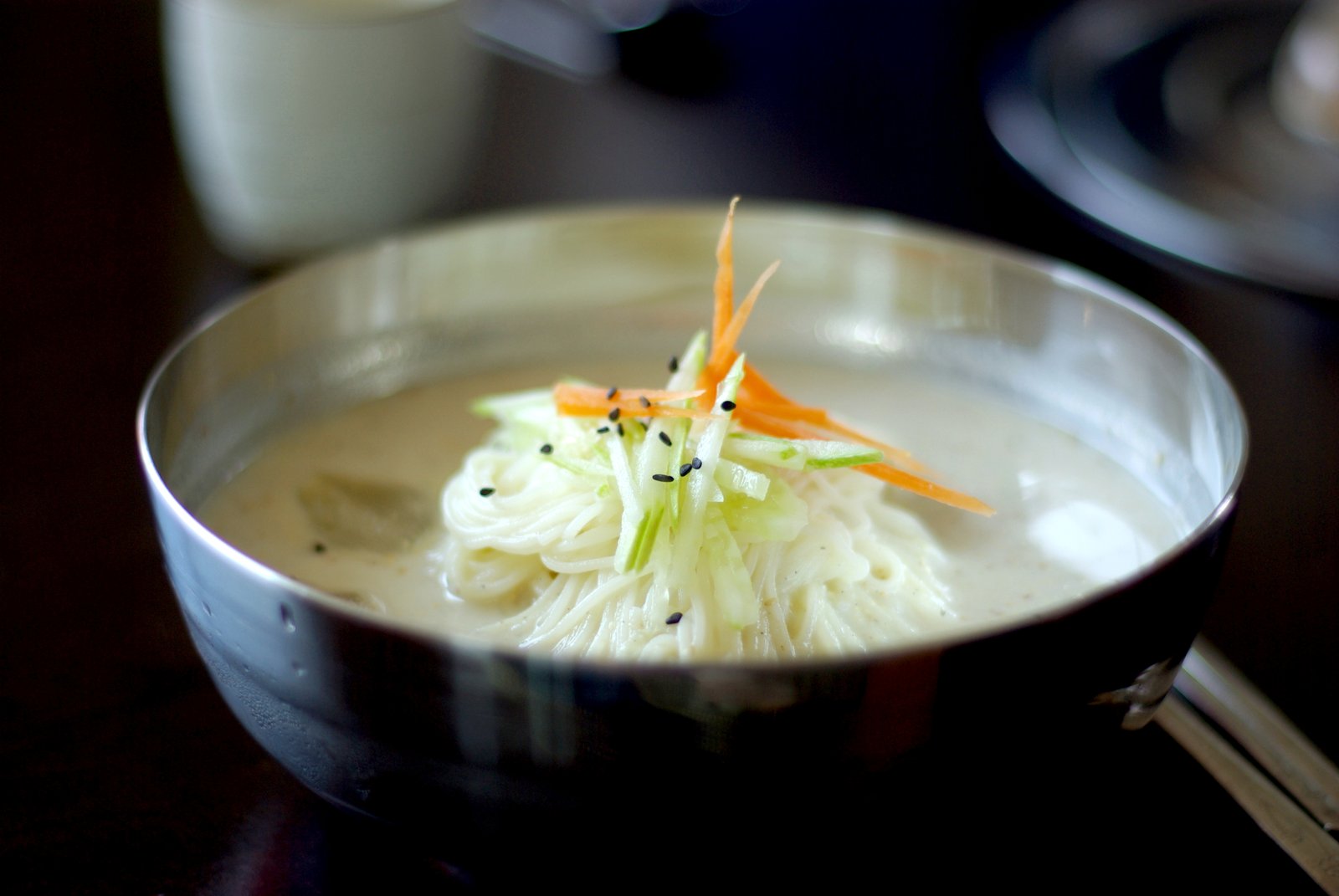
Soybeans boiled for just a few minutes, blended with water into a thick, nutty soy milk and poured ice-cold over thin wheat noodles. You season it with salt at the table. About 45 minutes for two, plus an overnight soak for the beans.
- Time
- 45 min
- Level
- Easy
- Spice
- Serves
- 2 servings
What is Kongguksu?
WHAT IT IS
Kongguksu is thin wheat noodles in an ice-cold, creamy broth made by blending lightly boiled soybeans with water. The broth is nutty and barely seasoned, so you salt your own bowl at the table. It's a summer dish, usually topped with cucumber and sometimes tomato or watermelon.
WHERE IT COMES FROM
Soybeans have long fed ordinary Korean households: the 18th-century scholar Yi Ik wrote in Seongho saseol that the fine grains went to the well-off while the poor got by on beans. A recipe much like today's appears in the 19th-century cookbook Siuijeonseo: soak the beans, blanch them briefly, strain them fine, season with salt and pour over wheat noodles. Because it keeps all the protein and fat of the beans, it has long been eaten to keep up strength in the sweaty summer months.
Ingredients
재료Each Korean item has a substitute, in case you can’t get to a store.
Paid links · The store links in this list are affiliate links: K for All earns a commission when you buy through them. Sales, shipping and refunds are handled by each store.
- 1 cup (6½ oz / 180 g)Dried yellow soybeans 콩
Jayone Soybeans (dried, meju-kong) · 4 lb
Substitute: Short on time? Blend 7 oz (200 g) soft tofu with 2 cups (480 ml) unsweetened soy milk and the nuts instead. It's lighter, but ready in minutes.
Check price on Amazon Amazon US - 2 tbsp (optional)Roasted peanuts, pine nuts or almonds 견과류·씨앗
Substitute: They make the broth richer and nuttier.
Any grocer - 1 tbsp, plus more to garnishToasted sesame seeds 통깨
Ottogi Roasted Sesame Seeds · 100 g
Check price on Amazon Amazon US - 2½–3 cups (600–720 ml)Ice-cold water, for blending 물In your pantry
- 7 oz (200 g)Thin wheat noodles (Korean somyeon or Japanese somen) 소면
JFC Tomoshiraga Somen (thin wheat noodles) · 16 oz
Substitute: Slightly thicker jungmyeon noodles are popular for kongguksu too; boil them a minute or two longer.
Check price on Amazon Amazon US - ½Cucumber, cut into thin matchsticks 오이Any grocer
- 1 small (optional)Tomato, sliced, or a few cubes of watermelon 토마토Any grocer
- Salt, for seasoning at the table; a few ice cubesIn your pantry


Method
만드는 법Sources we compared:Korean Bapsang10000recipe10000recipe (tofu shortcut)
- 1
Soak the beans overnight
Rinse the soybeans and cover them with plenty of cold water; they'll more than double in size. Soak for at least 8 hours or overnight, in the fridge if your kitchen is warm.
Fully soaked beans split cleanly in half, with no hard, pale core in the middle.
- 2
Boil briefly
Drain the beans, put them in a pot with fresh water to cover by about 1 inch (2–3 cm) and bring to a boil over high heat. Turn the heat to medium and cook for 5–10 minutes, stirring now and then. Start tasting at 5 minutes: they're done when a bean tastes nutty rather than grassy. Drain right away.
Timing matters most. Undercooked beans taste grassy; overcooked ones turn heavy and smell like fermented bean paste.
- 3
Cool and rub off the skins
Plunge the beans into cold water and rub them between your hands. The loose skins float to the top; pour them off with some of the water, add fresh water and repeat 2 or 3 times. You don't need to remove every skin.
- 4
Blend and chill
Blend the beans with the nuts, 1 tbsp sesame seeds and 2½ cups (600 ml) ice-cold water for 2–3 minutes, until as smooth as you can get it; work in two batches if your blender is small. Add up to ½ cup (120 ml) more water for a thinner broth, and press it through a fine sieve if you want it silky. Chill until very cold, at least 30 minutes.
The soy milk keeps for up to 3 days in the fridge. It settles as it sits, so stir before pouring.
- 5
Cook the noodles and serve
Boil the noodles for about 3 minutes (check the package), stirring so they don't clump. Drain, rinse under cold running water, rubbing them to wash off the starch, and shake dry. Divide between two bowls, pour the soy milk over and top with cucumber, tomato, a pinch of sesame seeds and a few ice cubes. Everyone salts their own bowl at the table.
Say it in Korean
한국어로 말해 보세요For a noodle shop in summer, when kongguksu goes on the menu.
Cookware you’ll need
조리 도구A pot and a blender are all you need. To boil the noodles a serving at a time, the Korean way, here's the light 6.3-inch noodle pot we link to.