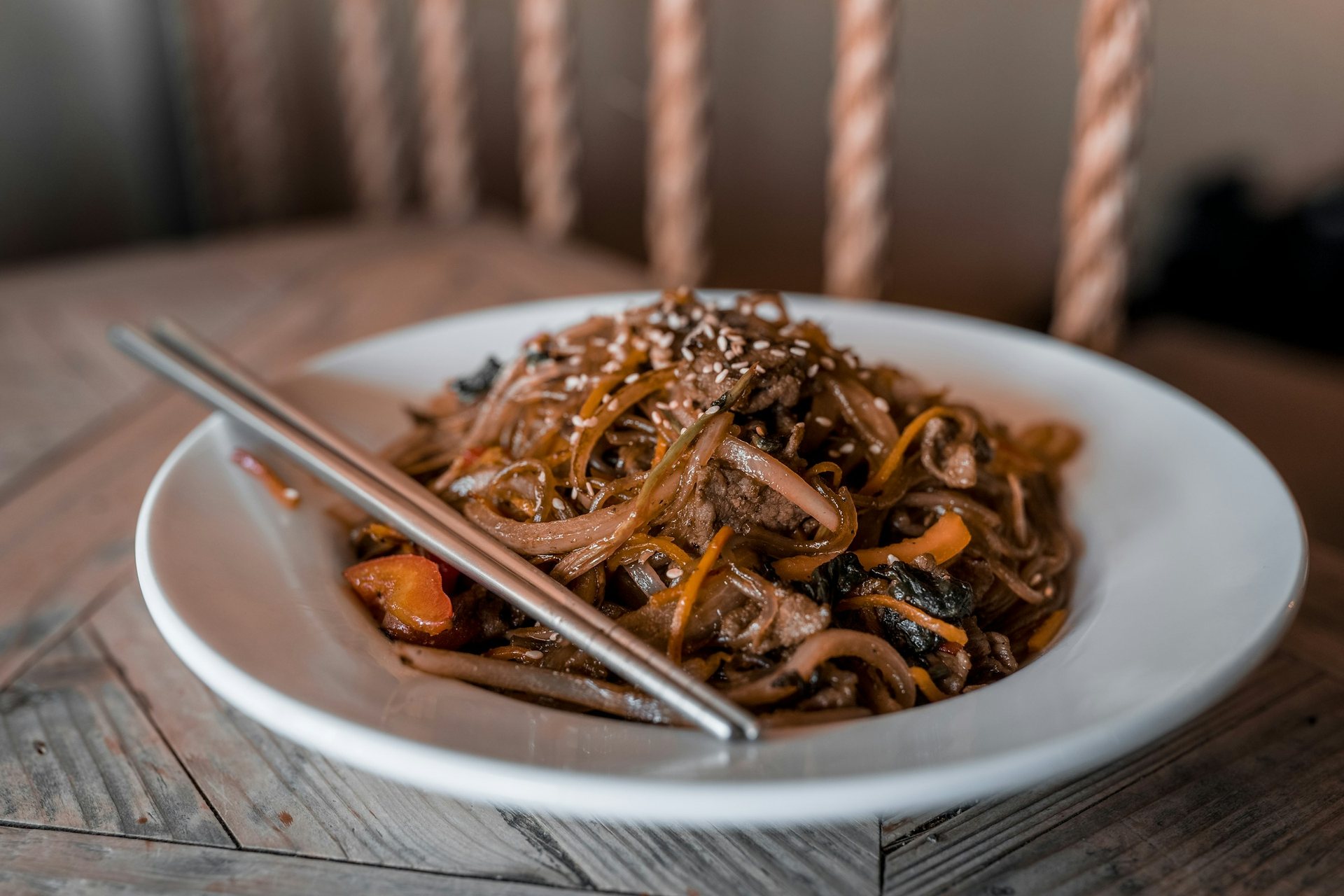
Japchae
Chewy sweet potato glass noodles tossed with beef, spinach, carrot and mushrooms in a sweet soy and sesame sauce. In The Legend of Kitchen Soldier, army cook Kang Seong-jae remakes his japchae until it wins over a regimental commander with a five-star palate. About 45 minutes for four.
- Time
- 45 min
- Level
- Medium
- Spice
- Serves
- 4 as a side, 2 as a main
What is Japchae?
WHAT IT IS
Japchae is sweet potato glass noodles (dangmyeon) tossed with stir-fried vegetables, mushrooms and beef in a sweet soy and sesame sauce. It is a fixture at birthdays, holidays and feasts.
WHERE IT COMES FROM
The name means “mixed vegetables,” and the oldest recipe, in the cookbook Eumsik Dimibang from around 1670, has no noodles at all: just stir-fried vegetables, mushrooms and pheasant under a thick sauce. In the early 1600s the official Yi Chung was mocked as the “japchae minister,” because his rise to Minister of Taxation was said to be owed to the dishes he sent King Gwanghaegun. Glass noodles came in the 20th century: Korea's first large dangmyeon factory opened in Sariwon in 1919, and recipes with noodles appear from the 1930s.
Sources:Encyclopedia of Korean CultureEncyclopedia of Korean Folk CultureEncyclopedia of Korean Culture (dangmyeon)Seoul Metropolitan Government
Ingredients
재료Each Korean item has a substitute, in case you can’t get to a store.
Paid links · The store links in this list are affiliate links: K for All earns a commission when you buy through them. Sales, shipping and refunds are handled by each store.
- 5 oz (150 g)Sweet potato glass noodles (dangmyeon) 당면
Ottogi Korean Vermicelli Premium Glass Noodles (Dangmyeon) · 500 g
Substitute: The 500 g bag we link to is 100% sweet potato starch; this recipe uses 150 g, so one bag makes three batches.
Check price on Amazon Amazon US - 5 oz (150 g)Tender beef such as sirloin or tenderloin, cut into thin strips 소고기
Substitute: Pork shoulder or loin works the same way. For a meatless japchae, leave it out and double the mushrooms.
Any grocer - 5 (about 3 oz / 85 g)Fresh shiitake mushrooms, stems removed, sliced 표고버섯
Substitute: Dried shiitake work too: soak 3 in warm water for a few hours, squeeze them dry and slice. Seong-jae's five-star version in the drama uses wild pine mushrooms (songi), torn by hand.
Any grocer - 1 small bunch (about 5 oz / 150 g)Spinach, roots trimmed 시금치Any grocer
- 1Medium carrot, cut into thin matchsticks 당근Any grocer
- 1 smallOnion, sliced thin 양파Any grocer
- 3Scallions, in 2-inch (5 cm) lengths 쪽파Any grocer
- 3 tbspSoy sauce 간장
Sempio Korean Soy Sauce, Rich and Delicate · 860 ml
Check price on Amazon Amazon US - 2 tbspSugar 설탕
Substitute: Brown sugar, honey or rice syrup all work. Add a little more at the end if you like it sweeter.
In your pantry - 2 tbspToasted sesame oil 참기름
Otoki Premium Roasted Sesame Oil · 10.82 fl oz
Check price on Amazon Amazon US -
- 3 cloves (1 tbsp)Garlic, minced 다진 마늘Any grocer
- 1Egg, for thin yellow and white egg strips (optional) 달걀Any grocer
- Cooking oil, salt and black pepperIn your pantry


Method
만드는 법Sources we compared:MaangchiMy Korean Kitchen10000recipe
- 1
Make the sauce and season the beef
In a small bowl, mix 3 tbsp soy sauce, 2 tbsp sugar, the garlic and ¼ tsp black pepper. This one sauce seasons the whole dish. Put the beef and mushrooms in another bowl with 1 tbsp of it and 1 tsp sesame oil, work it in with your fingers and let them sit while you prep the rest. Cut the carrot into thin matchsticks, slice the onion thinly, cut the scallions into 2-inch lengths and wash the spinach well.
Seong-jae's turning point in episode 9: he stops slicing the wild pine mushrooms with a knife and tears them along the grain, because torn by hand they keep their aroma. If you use oyster mushrooms, tear them by hand the same way.
- 2
Blanch the spinach, then boil the noodles in the same water
Fill a large pot with water and bring it to a rolling boil. Dip the spinach in for 30 seconds, scoop it out with a strainer and cool it under cold water, leaving the pot on the heat. Drop the noodles into the same water and boil until soft and springy with no hard core, 7–8 minutes (check the package). Drain, rinse briefly under cold water, drain well and snip through the pile 2 or 3 times with kitchen scissors. Toss the noodles with 2 tsp sesame oil in a bowl to keep the strands separate. Squeeze the spinach dry, chop it once or twice, season it with 1 tsp sesame oil and a pinch of salt and put it in a large mixing bowl.
- 3
Stir-fry the vegetables, palest first
If you're making the egg garnish, do it first: beat the yolk and the white separately with a pinch of salt, then cook each as a thin sheet over low heat in a nonstick skillet brushed with a little oil, about 1 minute a side, without letting it brown. Roll up and cut into thin strips. Turn the same skillet to medium-high, add 1 tsp oil and stir-fry the onion and scallions with a pinch of salt until the onion just turns translucent, about 2 minutes; tip them into the large bowl. Add a little more oil and stir-fry the carrot with a pinch of salt for about 1 minute so it stays crisp (½ red bell pepper in thin strips can go in with it), then add it to the bowl.
Working from the palest ingredients to the darkest lets one skillet handle every batch without washing. If anything sticks, a quick wipe with a paper towel is enough.
- 4
Cook the beef and mushrooms, then glaze the noodles
Add 1 tsp oil and stir-fry the beef and mushrooms with their marinade over medium-high heat until the beef is just cooked through, 2–3 minutes; add them to the large bowl. Turn the heat down to medium, pour all the remaining sauce into the skillet and add the noodles. Stir-fry for about 2 minutes, until the noodles have soaked up the sauce and look glossy and evenly brown, then add them to the bowl.
- 5
Toss and serve
Add the last 2 tsp sesame oil and the sesame seeds to the bowl and toss everything together, with tongs while the noodles are hot and with gloved hands once they cool a little. Taste, and add a splash of soy sauce or a pinch of sugar if needed. Pile it on a platter and scatter the egg strips on top. Japchae is good warm or at room temperature.
Spoon it over a bowl of rice and it becomes japchae-bap, a standard on Korean-Chinese restaurant menus.


Say it in Korean
한국어로 말해 보세요For a Korean-Chinese restaurant, a party table or your own kitchen.

Cookware you’ll need
조리 도구Any wide nonstick skillet works for the stir-frying (the spinach and noodles boil in a separate large pot). This is the 5-quart sauté pan we link to.