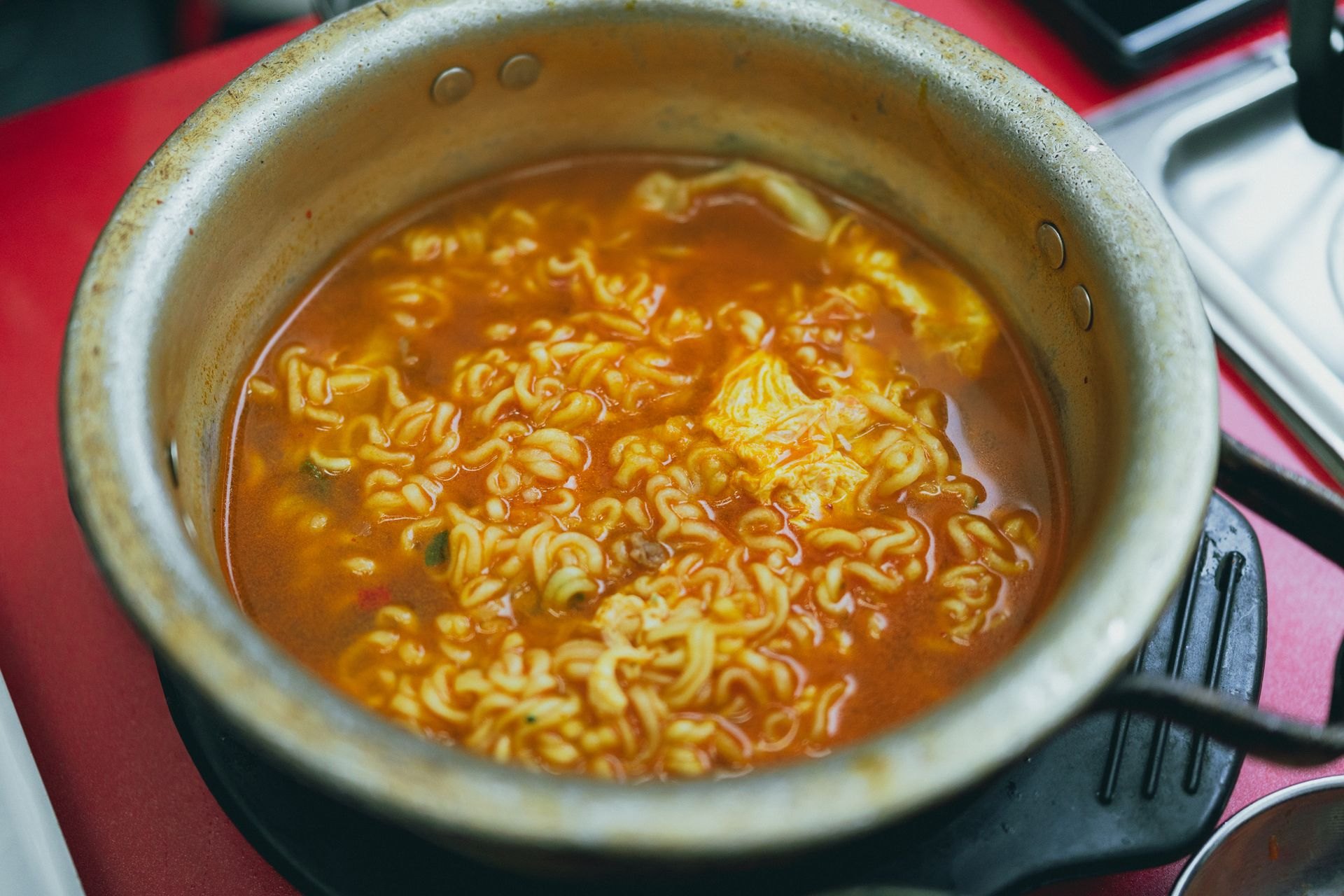
Baechu-kimchi
A whole napa cabbage is salted for hours, then every leaf is spread with a paste of gochugaru, garlic, ginger, fish sauce and salted shrimp, with crunchy radish and scallions. It ferments on the counter for a day or two and keeps developing in the fridge for weeks. About 8½ hours from cabbage to jar, most of it hands-off salting; makes about 3 quarts.
- Time
- 510 min
- Level
- Medium
- Spice
- Serves
- About 3 qt (3 L)
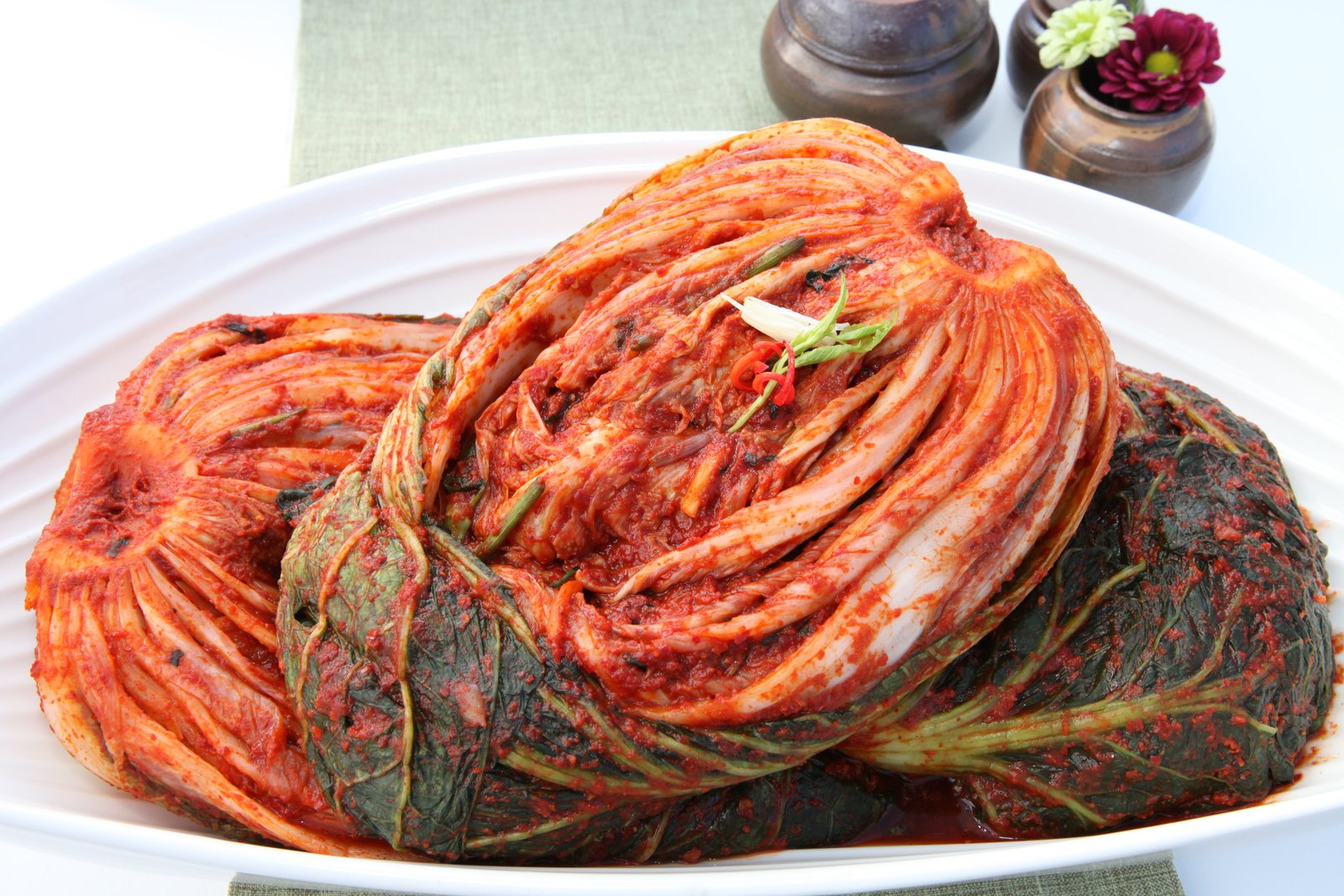
What is Baechu-kimchi?
WHAT IT IS
Baechu-kimchi is napa cabbage that is salted, rubbed leaf by leaf with a paste of red pepper flakes, garlic, ginger, fish sauce or salted seafood and scallions, and left to ferment. It's the kimchi most Koreans mean when they just say kimchi, and it's part of almost every Korean meal: crisp and fresh at first, then more sour as it ages.
WHERE IT COMES FROM
Salted vegetables were part of Korean life long before chili: the Goryeo poet Yi Gyu-bo wrote of salting radish to last the winter. According to the Encyclopedia of Korean Culture, chili peppers reached Korea in the middle of the Joseon era, and the 1766 cookbook Jeungbo Sallim Gyeongje is among the earliest records of chili in kimchi; the tightly packed napa cabbage used today only became common in roughly the last century. Kimjang, the late-autumn custom of making and sharing a winter's worth of kimchi, was inscribed on UNESCO's Representative List of the Intangible Cultural Heritage of Humanity in 2013.
Sources:Encyclopedia of Korean Culture (김치)Encyclopedia of Korean Culture (김장)UNESCO: Kimjang, making and sharing kimchi in the Republic of KoreaNational Institute of Korean Language (한식명 로마자 표기 및 표준 번역, 2014)
Ingredients
재료Each Korean item has a substitute, in case you can’t get to a store.
Paid links · The store links in this list are affiliate links: K for All earns a commission when you buy through them. Sales, shipping and refunds are handled by each store.
- 1 large (5–6 lb / about 2.5 kg)Napa cabbage (baechu) 배추
Substitute: Pick a heavy head with crisp, tightly packed leaves. Two smaller heads of about 3 lb (1.3 kg) each work the same way.
Any grocer - 1 cupCoarse sea salt, non-iodized 굵은소금
Substitute: Korean cooks use coarse sea salt (cheonilyeom). Coarse kosher salt also works. Avoid fine iodized table salt: it dissolves too fast and over-salts the leaves.
In your pantry - 1 lb (450 g)Korean radish (mu) or daikon, cut into thin matchsticks 무Any grocer
- 4–5Scallions, cut into 1-inch (2–3 cm) pieces 쪽파
Substitute: A handful of garlic chives (buchu) or Korean mustard greens (gat) is a classic addition.
Any grocer - 1½ tbspSweet (glutinous) rice flour, for a thin rice porridge 찹쌀가루
Koda Farms Mochiko Sweet Rice Flour · 16 oz × 2
Substitute: The porridge helps the paste cling to the leaves and is said to help the kimchi ferment. All-purpose flour cooked the same way also works.
Check price on Amazon Amazon US - ¾ cup (about 70 g)Gochugaru (Korean red pepper flakes), coarse 고춧가루
Taekyung Red Pepper Powder · 1 lb
Substitute: Use ½ cup for a milder, lighter-red kimchi, or up to 1 cup for a fiery one. Other chili flakes are much hotter and are not a one-for-one swap.
Check price on Amazon Amazon US - 4 tbspFish sauce, ideally Korean anchovy fish sauce (myeolchi-aekjeot) 멸치액젓
Chung Jung One Premium Anchovy Fish Sauce Gold · 1.1 lb (500 g)
Substitute: For a vegan kimchi, replace the fish sauce and salted shrimp with soup soy sauce or a little more salt, and simmer a piece of kelp in the porridge water.
Check price on Amazon Amazon US - 3 tbspSalted fermented shrimp (saeujeot), finely chopped 새우젓
Substitute: Sold in the refrigerated section of Korean grocers. Without it, add 1–2 tbsp more fish sauce.
Any grocer - 10 cloves (3 tbsp)Garlic, minced 다진 마늘Any grocer
- 2 tspFresh ginger, grated 생강Any grocer
- 1 tsp sugar (or ¼ Asian pear, grated), and ¾ cup water for the rice porridge. You'll also need two large bowls, a colander, kitchen gloves and a container of about 1¼ gallons (5 L)In your pantry


Method
만드는 법Sources we compared:Korean Bapsang10000recipeColorado State University Extension (food safety)Oregon State University Extension (food safety)
- 1
Split and salt the cabbage
Trim the root end, cut a slit about 3 inches (8 cm) into the base and pull the head apart into halves with your hands; do the same again to make quarters, so the leaves stay whole. In a large bowl, dissolve ½ cup of the salt in 6 cups (1.5 L) water. Dunk each quarter in the brine, then sprinkle the remaining ½ cup salt between the leaves, mostly on the thick white stems. Pour the rest of the brine over the cabbage and leave it for 6–8 hours, moving the bottom quarters to the top every 2 hours.
It's ready when a thick white stem bends without snapping. A warm kitchen speeds this up; a cold one slows it down.
- 2
Rinse and drain
Rinse each quarter three times in cold water, opening the leaves so the salt washes out from between them. Squeeze gently, then set the quarters cut side down in a colander to drain for at least 1 hour.
Taste a piece of stem: it should be pleasantly salty, like a potato chip. If it's much saltier, soak the quarters in fresh water for 10–15 minutes and drain again.
- 3
Make the paste
While the cabbage drains, stir 1½ tbsp sweet rice flour into ¾ cup water in a small pot and cook over low heat, stirring, for 3–4 minutes, until it turns into a thin, glossy porridge. Let it cool completely. In a large bowl, mix the porridge with the gochugaru, fish sauce, salted shrimp, garlic, ginger and sugar, and let it stand for 10 minutes so the pepper flakes soften. Add the radish and scallions and mix well with gloved hands.
Taste the paste. It should be a little saltier than you'd want to eat on its own, because the cabbage and radish absorb the seasoning; add a splash more fish sauce if it tastes flat.
- 4
Stuff and pack
Working with one quarter at a time, lift each leaf, starting from the outside, and spread a thin layer of paste over it from the stem toward the tip. Fold the quarter in half and wrap it with its outermost leaf. Pack the quarters tightly, cut side up, into a clean glass or food-grade plastic container, pressing down to push out air pockets. Fill it no more than about two-thirds full, because fermenting kimchi releases gas and liquid. Swish ¼ cup water around the paste bowl and pour it over the top.
Wash the container in hot, soapy water and use clean, dry utensils. Don't ferment kimchi in a metal container or in cracked or chipped earthenware.
- 5
Ferment, then refrigerate
Cover tightly and leave the kimchi at cool room temperature, around 68°F (20°C), for 1–2 days, until small bubbles appear and it smells pleasantly sour. Press it down once a day with a clean spoon so the cabbage stays under its juices, then move it to the refrigerator. You can eat it right away, but the flavor deepens over the next couple of weeks, and it keeps for months in the fridge, slowly growing more sour.
Always take kimchi out with clean utensils and keep the rest pressed under its liquid. Throw it out if fuzzy mold appears on the surface or the cabbage turns soft and slimy. A strong sour smell on its own is normal: very sour kimchi is perfect for kimchi jjigae.
Say it in Korean
한국어로 말해 보세요For any Korean restaurant, where kimchi comes as a side dish.