Gamjatang
Meaty pork bones simmered until the meat slips off, then boiled with potatoes, cabbage and a spicy doenjang-and-gochugaru paste and finished with perilla leaves and ground perilla seeds. A long, slow pot for a cold night. About 180 minutes for four, including soaking the bones.
- Time
- 180 min
- Level
- Medium
- Spice
- Serves
- 4
What is Gamjatang?
WHAT IT IS
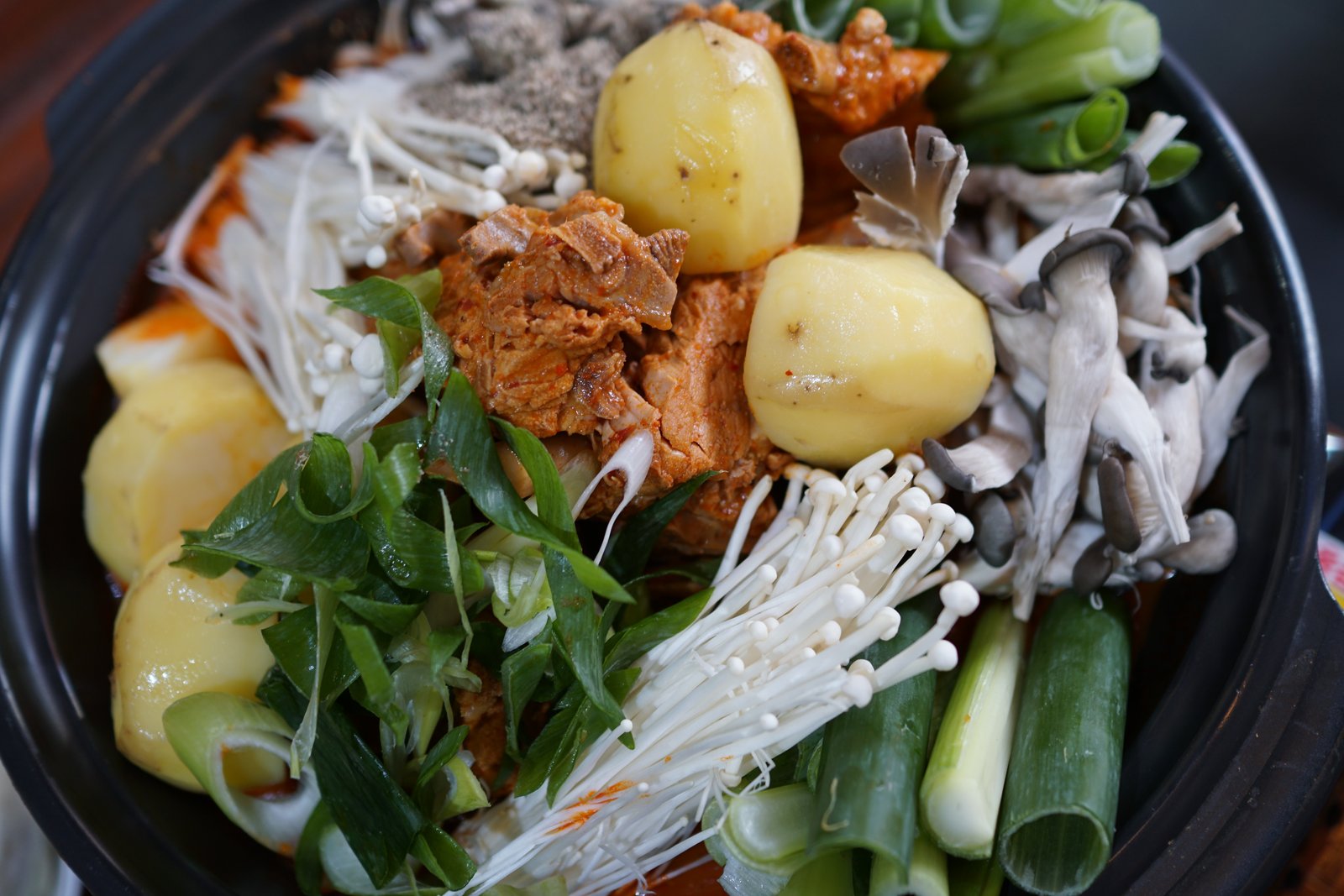
Gamjatang is a hearty, spicy stew of pork neck or back bones simmered until the meat is falling off, then boiled with potatoes, napa cabbage or dried cabbage leaves, perilla leaves and ground perilla seeds. It comes to the table in a big pot to share, and you pick the tender meat from between the bones with chopsticks.
WHERE IT COMES FROM
There is no firm written record of where or when gamjatang began, says the Encyclopedia of Korean Folk Culture, and even the name is debated: gamja means potato, but some trace it to the pork backbone, the reading the encyclopedia finds more convincing. According to the Korean Food Promotion Institute's magazine, Seoul's eateries long served haejangguk made with beef bones; in the 1970s, as pig farming grew and workers poured into Seoul, cheap, filling pork-bone soups (gamjaguk) caught on, first in single bowls and later in big pots to share. Franchise chains later made it a dish known all over Korea.
Sources:Encyclopedia of Korean Folk CultureKorean Food Promotion InstituteKorea Tourism Organization
Ingredients
재료Each Korean item has a substitute, in case you can’t get to a store.
Paid links · The store links in this list are affiliate links: K for All earns a commission when you buy through them. Sales, shipping and refunds are handled by each store.
- 3 lb (1.4 kg)Pork neck bones or back (spine) bones, as meaty as you can find 돼지 등뼈
Substitute: Korean grocers sell them frozen and cut for gamjatang. Thaw frozen bones in the fridge overnight before soaking.
Any grocer - 4 medium (about 1¼ lb / 600 g)Potatoes, peeled and halved 감자Any grocer
- ½ small head (about 10 oz / 300 g)Napa cabbage 배추
Substitute: Many restaurants use ugeoji (boiled outer leaves of napa cabbage), sold vacuum-packed at Korean grocers. Use the same weight, rinsed and squeezed, and skip the blanching in step 3.
Any grocer - 10 leavesPerilla leaves (kkaennip), roughly torn 깻잎Any grocer
- 3Scallions, cut into 2-inch (5 cm) lengths 대파Any grocer
- 1 mediumOnion, halved, for the broth 양파Any grocer
- 10 clovesGarlic: 4 whole cloves for the broth, 6 minced for the seasoning 마늘Any grocer
- 1-inch piece (about 15 g)Ginger, sliced, for the broth 생강Any grocer
- 2 tbspDoenjang (Korean soybean paste): 1 tbsp for the broth, 1 for the seasoning 된장
CJ Haechandle Doenjang (Korean Soybean Paste) · 500 g
Check price on Amazon Amazon US - 3 tbspGochugaru (Korean red pepper flakes) 고춧가루
Taekyung Red Pepper Powder · 1 lb
Substitute: Use 1½ tbsp for a medium-hot pot.
Check price on Amazon Amazon US - 1 tbspGochujang 고추장
CJ Haechandle Gochujang (Hot Pepper Paste) · 500 g
Check price on Amazon Amazon US - 2 tbspFish sauce or soup soy sauce (gukganjang) 멸치액젓Any grocer
- ¼ cupGround perilla seeds (deulkkae-garu) 들깻가루
Substitute: They thicken the broth and give it a nutty finish. Ground toasted sesame seeds are the usual stand-in.
Search on Amazon Amazon US - 10 cups (2.4 L)Water, for the broth 물In your pantry
- 1 tsp whole black peppercorns for the broth (optional), ½ tsp ground black pepper, salt to tasteIn your pantry
-


Method
만드는 법Sources we compared:MaangchiKorean BapsangMy Korean Kitchen
- 1
Soak and blanch the bones
Rinse the bones and soak them in cold water for 1 hour (at least 30 minutes), changing the water once, to draw out the blood. Drop them into a pot of boiling water and boil hard for 7–8 minutes, until gray scum rises. Drain, then rinse each bone under running water, rubbing off the scum and any bone chips, and wash out the pot.
Don't skip this. Blanching and rinsing is what keeps the broth clean-tasting instead of murky and gamey.
- 2
Simmer the broth
Return the bones to the clean pot with the 10 cups (2.4 L) of water, the onion, ginger, 4 whole garlic cloves, 1 tbsp doenjang and the peppercorns. Bring to a boil, then cover and simmer over medium-low heat for 75–90 minutes, until the meat is tender and pulls away from the bone easily. Meanwhile, mix the seasoning paste: the 6 minced garlic cloves, gochugaru, gochujang, 1 tbsp doenjang, fish sauce, half the ground perilla seeds, the ground pepper and 3 tbsp water.
- 3
Prepare the potatoes and cabbage
While the broth simmers, boil the potatoes in a separate pot of water for about 10 minutes, until almost tender. In more boiling water, blanch the cabbage for 2–3 minutes, rinse it in cold water, squeeze and tear it lengthwise into long strips. Toss the cabbage with 1 tbsp of the seasoning paste.
- 4
Season and boil together
Lift out and discard the onion, ginger and garlic (or strain the broth and return the bones); you should have about 7 cups of broth. Add the potatoes, cabbage and the rest of the seasoning paste. Boil over medium-high heat for 15–20 minutes, until a chopstick slides easily through the potatoes. Taste and add salt or a little more fish sauce if needed.
After this long simmer the pork is cooked far beyond 145°F (63°C), the safe minimum for pork. The sign to look for is meat that comes away from the bone at a touch, with no pink near the bone.
- 5
Finish with perilla and serve
Add the perilla leaves, scallions and the remaining ground perilla seeds, and boil for 1–2 minutes more. Bring the pot to the table with rice, kimchi and an empty bowl for the bones, and ladle bones, potatoes and broth into individual bowls.
The leftover broth is a treat: boil instant noodles in it, or add rice, chopped kimchi and gim and fry it in the pot until it crisps on the bottom.
Say it in Korean
한국어로 말해 보세요For a gamjatang restaurant, where the pot keeps boiling at your table.
Cookware you’ll need
조리 도구Cook it in any large pot that holds 4 quarts (about 4 L) or more. To bring a single portion to the table still bubbling, the way haejangguk shops do, here's the 44 fl oz stone pot we link to.