Dakgangjeong
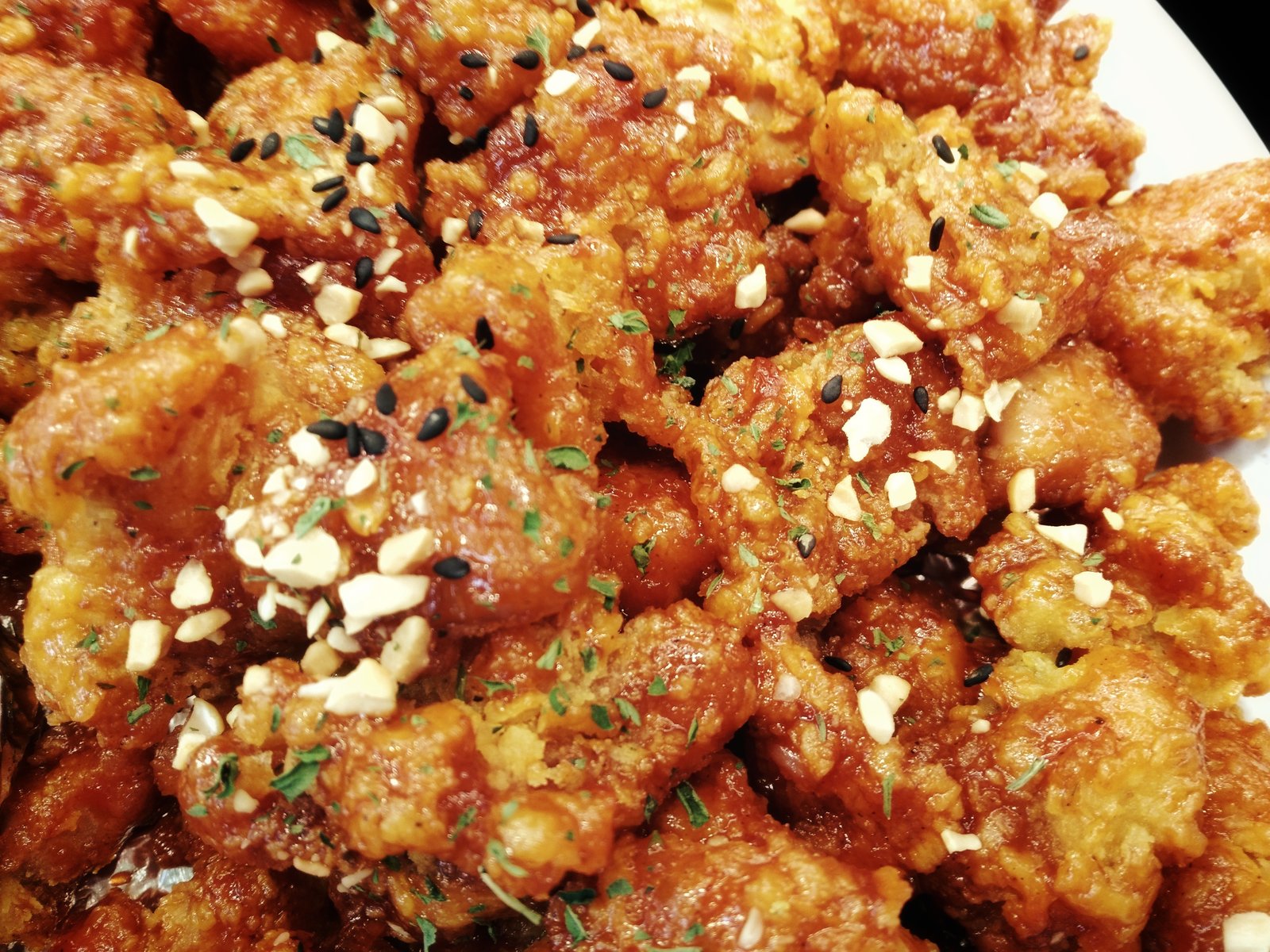
Bite-size pieces of boneless chicken, fried twice until crackly, then tossed in a sticky glaze of corn syrup, soy sauce and a little gochujang and scattered with peanuts. The syrup glaze keeps it crunchy even after it cools, and it's a favorite snack at Korean traditional markets. About 60 minutes for four.
- Time
- 60 min
- Level
- Medium
- Spice
- Serves
- 4
What is Dakgangjeong?
WHAT IT IS
Dakgangjeong is bite-size boneless fried chicken coated in a sweet, sticky glaze of syrup, soy sauce and garlic, usually with a little gochujang or chili, and finished with crushed nuts. Regular fried chicken goes soft as it cools, but dakgangjeong stays crunchy, because the syrup glaze sets around the crisp coating.
WHERE IT COMES FROM
The name borrows from gangjeong, a centuries-old Korean confection of fried glutinous-rice dough coated in syrup and seeds, served at ancestral rites and weddings. When and where dakgangjeong itself began is not recorded, and it's unknown whether Chinese or Western fried chicken inspired it. Today it's closely tied to traditional markets: the Korean Culture and Information Service names Sinpo International Market in Incheon and Sokcho Central Market in Gangwon-do as the two most famous places to eat it.
Sources:Korean Culture and Information Service, KOREA webzine (Oct 2020)Encyclopedia of Korean Culture (강정)
Ingredients
재료Each Korean item has a substitute, in case you can’t get to a store.
Paid links · The store links in this list are affiliate links: K for All earns a commission when you buy through them. Sales, shipping and refunds are handled by each store.
- 1½ lb (700 g)Boneless, skinless chicken thighs, cut into 1½-inch (4 cm) pieces 닭다리살
Substitute: Breast meat works too but dries out faster; cut it a little bigger and fry it a minute less. Pat the pieces dry before seasoning.
Any grocer - ¾ cup (100 g)Potato starch or cornstarch 감자 전분
Substitute: Potato starch gives the thinnest, crispiest shell. For a thicker crust, use half starch and half Korean frying mix (twigim garu).
Search on Amazon Amazon US - About 6 cups (1.5 L)Neutral oil for deep-frying, such as canola or peanut 튀김용 기름In your pantry
- 5 tbspCorn syrup (mulyeot) or rice syrup 물엿
Chung Jung One O’Food Corn Syrup · 1.2 kg
Substitute: The syrup is what keeps the coating crunchy after it cools. Honey works too, but it scorches faster, so keep the heat low.
Check price on Amazon Amazon US - 2 tbspSoy sauce 간장
Sempio Korean Soy Sauce, Rich and Delicate · 860 ml
Check price on Amazon Amazon US - 1½ tbspGochujang 고추장
CJ Haechandle Gochujang (Hot Pepper Paste) · 500 g
Substitute: Leave it out for a sweet soy-garlic version (ganjang dakgangjeong), or add a sliced fresh chili for more heat.
Check price on Amazon Amazon US - 1 tbspBrown sugar 황설탕In your pantry
- 4 cloves (1 tbsp)Garlic, minced 다진 마늘Any grocer
- 3 tbspRoasted peanuts, coarsely chopped 견과류·씨앗
Substitute: Almonds, walnuts or toasted sesame seeds work as well. Leave them out for a nut-free version.
Any grocer - For the chicken: ½ tsp salt, ¼ tsp black pepper, 1 tsp grated ginger and 1 tbsp rice wine. For the glaze: 2 tbsp water and 1 tsp toasted sesame oilIn your pantry


Method
만드는 법Sources we compared:Korean Bapsang10000recipe
- 1
Cut and season the chicken
Trim off any large pieces of fat, pat the chicken dry and cut it into 1½-inch (4 cm) pieces. Toss with ½ tsp salt, ¼ tsp black pepper, 1 tsp grated ginger and 1 tbsp rice wine, and let it sit for 20 minutes while you make the glaze.
For extra-tender chicken, soak the pieces in ½ cup milk in the refrigerator for 30 minutes first, then drain them well and skip the rice wine.
- 2
Make the glaze
In a wide pan, big enough to toss all the chicken later, stir together 5 tbsp corn syrup, 2 tbsp soy sauce, 1½ tbsp gochujang, 1 tbsp brown sugar, the garlic and 2 tbsp water. Bring it to a boil over medium heat, then simmer for 2–3 minutes, stirring, until glossy and slightly thickened. Stir in 1 tsp sesame oil and turn off the heat.
The glaze thickens as it cools. If it's too stiff by the time the chicken is fried, loosen it over low heat with a spoonful of water.
- 3
Coat in starch
Pat the chicken dry again with paper towels. Put the starch in a bowl or a large zip-top bag, add the chicken and toss, pressing the starch on until every piece is coated. Spread the pieces on a tray for 5 minutes so the coating looks damp, then shake off any loose starch.
- 4
Fry twice
Pour at least 1½ inches (4 cm) of oil into a heavy, deep pot and heat it to 340°F (170°C). Fry the chicken in two or three batches without crowding for 4–5 minutes, until pale golden and cooked through (165°F / 74°C in the center). Drain on a wire rack. When all the chicken is done, heat the oil to 360°F (180°C) and fry it again, in one or two batches, for 1–2 minutes, until deep golden and crisp.
Never leave hot oil unattended, keep the pot no more than half full, and lower the chicken in gently. Without a thermometer, dip a dry wooden chopstick into the oil: a steady stream of small bubbles around it means the oil is ready.
- 5
Toss and serve
Warm the glaze over medium-low heat until it bubbles, add the fried chicken and toss for 30–60 seconds, until every piece is coated. Scatter the peanuts over the top and serve warm or at room temperature.
It stays crunchy as it cools, so it packs well for a picnic or a lunchbox.
Say it in Korean
한국어로 말해 보세요For a dakgangjeong stall at a traditional market.
Cookware you’ll need
조리 도구Any deep, heavy pot works for frying. A thermometer is the one tool worth buying for frying twice; this is the one we link to.